Showing posts with label Fantasy. Show all posts

Sunday, June 11, 2017

Continuum 2017


I had myself the loveliest little nerdy writerly day today. I went to Continuum 13, the Australian speculative fiction conference.

The con runs over the Queen's Birthday long weekend each June, and I have wanted to go for literally *years*. But the kids were too little to leave for a while ... then I was too sick for a couple of years ... then it collided with OzComicCon, at which I have standing duties helping out at a friend's merch stall.

This year, the stars finally aligned and I was able to get in for a full day today. Truth be told, I could've gone for two days if I had wanted to, but I felt bad about leaving my family for too much of the long weekend, and I have found in the past that two days of a con often exhausts me. So, after perusing the program, I picked today to go, and I had just the best time.

Writer / reader cons like this are such a different beast to the pop culture nerdcons like ComicCon and Supanova, with their teeming thousands. This was a small, intimate con - panel audiences ranged from maybe 25 to 80 in size, and there was ample opportunity to talk to panellists both within sessions and afterwards. People were chatty, and the atmosphere was friendly. Blessedly, it was not crowded at any time - that was a huge plus for me.

The con's guest of honour was prolific urban fantasy, horror and sci fi writer Seanan McGuire (who also writes as Mira Grant). I have read, and liked, several of McGuire's books, and really enjoyed her Newsflesh canon as Mira Grant (it has the distinction of being literally the only zombie series I have EVER enjoyed, or indeed finished). I was perhaps not as huge a fan as some of my friends, although after her highly engaging, entertaining and insightful (not to mention funny) keynote, I am now! I'd heard she was a good speaker but the reports failed to do her justice - she was excellent. Her session was my biggest highlight of a day that wasn't short on good moments.

I also went to panels on:

- Fairytales and fairytale retellings: This was terrific, and has inspired me to go back to my Month of Poetry poems from this year.

- White-washing in speculative fiction: This was interesting, if a little diffuse.

- Journey to the West: This was a great session on the Chinese classic novel that has been adapted multiple times for multiple media - the best-known version to Western viewers being the Monkey TV series.

- Cli-Fi: This panel, about climate change fiction, was probably really good, but as I couldn't hear most of it, I wouldn't know. The room it was in had no soundproofing and was directly adjacent to the very noisy dealers' area.

- Women in Star Wars: This was just pure fun. One of my friends was a panellist, and I could've listened to the 5 panellists talk for a LOT longer.

- Cityscapes: I almost didn't hang around for the last session but I am so glad I did - this was fantastic, probably the most thinky panel of the day, and I am still musing on it.

Overall, it was a day exceedingly well spent in terms of enjoyment, inspiration for my own writing, and connection. I will 100% be back next year!

Saturday, July 25, 2015

Reading Notes: Penric's Demon

One of my oldest friends introduced me to the amazing Lois McMaster Bujold a couple of years ago now - the year that Captain Vorpatril's Alliance was nominated for the Hugo, from memory. I have since read my way voraciously through her science fiction Vor canon, as well as her fantasy works.

Of all of these, although I recognise the greatness of Vor (who doesn't?), I have to say my heart belongs to the world of the Five Gods, heretofore delivered via only three too-brief novels (The Curse of Chalion, Paladin of Souls, and The Hallowed Hunt).

I have written before about what an achievement and a delight these books are, especially in Bujold's complex, thoughtful and nuanced treatment of religion, faith and free will in a world where the gods are opaque but active, and where the survival of human souls, which are claimed by the gods at death, is more certain, although still not assured.

The characters in these books are, even by Bujold's considerable standards, exceptional - some of the deepest, best-rounded of all her people. (Well ... excepting Miles Vorkosigan, of course. But then, there is only one Miles). In particular, the Lady Ista, heroine of Paladin of Souls, is one of the best-developed women I have ever read - a 40-year-old widow who is given a full, rich plot arc, the complete range of human capacity and emotion, and a (somewhat) happy ending. It's sufficiently unusual in fantasy for women with adult children to be written as key actors, let alone objects of passion rather than merely affection, that this stood out to me. (Yes, I know there are such characters in Game of Thrones, but I don't read those, so bear with me. It is still unusual, anyway).

So it has always been something of a disappointment to me that the Five Gods canon was so brief. There were so many themes and areas of interest introduced that never had an adequate chance for development, and I've been hankering after more ever since I finished The Hallowed Hunt.

Penric's Demon, which is a perfectly balanced, wonderfully engaging, warm and gentle novella, has proved an eminently satisfactory sop to this particular hunger. (A sop, mind - it's not enough, more novels are required please Ms Bujold!)

In this short book, Bujold builds on an under-explored area in the three novels - sorcery, which in the Five Gods universe, means possession by a demon. This isn't nearly as horrific as it sounds; like everything in Bujold, it can be disturbing, off-key and dangerous, but the converse is that it can also be a source of not just power, but also regeneration, balance, and self-knowledge. Demons, the chaos-spirits belonging to the fifth god (the best of all the five, the Bastard), inhabit humans, but they don't possess them in the classical sense. Rather, they form a somewhat uneasy symbiosis with their human host - if the host understands how to control and use the demon, that is.

In previous Five God stories, the subject of demons has frequently arisen, but never from an intimate perspective. Penric, the protagonist of this tale, changes all that. A hapless minor lord on his way to a financially advantageous betrothal, Penric encounters a dying woman on the road; a woman, as luck would have it, who possesses a valuable, powerful demon. In her dying, she passes the demon on to Penric ... and this is the whole meat of the story.

Penric himself is an extremely likeable character; thoughtful, compassionate, intelligent, and kind. It is these qualities that give him the interest in, and the will to, seek to understand not just his demon's powers, but her essence. (The demon, who has previously inhabited 12 women in sequence, is most decidedly female). Pen learns more about what his demon is, and how she experiences the world, than all the learned divines and their esoteric knowledge. And it all begins when he bestows upon her a name - Desdemona.

This is a really warming, lovely story - entirely positive and upbeat in its affect, and that is not something often said about demon possession tales. It's probably not the ideal entry point into the Five Gods world - I think those who have read the novels will get much more out of it, and enjoy it more, than "cold" readers. Still, background or not, I think it would be hard not to be charmed by this gem of a novella.

Friday, May 15, 2015

Making a Golden Snitch Cake

It is my second girl's 10th birthday party on Saturday - the much-discussed and heavily-planned-for Harry Potter themed extravaganza. Preparations proceed apace, but one of the biggest items that we needed to concentrate on - as always - was the cake. So, with the help of my lovely cake decorating friend K, last Saturday was dedicated to the construction of ... the Golden Snitch.

The steps to making this cake weren't as onerous as they might, at first glance, appear. It was a lot less labour-intensive than earlier cakes we have done, such as Dorothy the Dinosaur, Lalaloopsy, or the memorable year that we made 110 cupcakes and decorated them all with chemical symbols to represent the Periodic Table of the Elements. (THAT was effort!)

So here's what we did, to make the Golden Snitch that we're all pretty happy with.


1. Acquire - buy, borrow or rent - a ball cake tin. It is *technically* possible to do this in a metal bowl, but I have to say, when I tried, it was a disaster. The soccer ball tin I bought - Wilton brand - wasn't cheap, but I intend to make many round cakes in the future now I have it, so the cost-per-bake will come out OK.

2. Bake 2x half-circle cakes. You are supposed to fill the tin to about 2/3 to 3/4, but I used gluten free batter and filled just over 3/4 and it didn't quite rise evenly to the top (close enough though). I would suggest a fairly dense cake, as anything light and fluffy like a sponge will just get crushed under the weight of the fondant that's coming up.

3. Wrap and freeze the cakes, preferably for at least 24 hours.
4. If you need to (and you probably will), use a breadknife to cut the non-flat end of the cakes to a level surface.

5. Make a very large amount of buttercream icing. By "very large", I used over 500g of icing sugar, mixed with margarine and a little hot water to loosen up. You want the buttercream to be thick - no dripping off the spoon!


6. Put Cake 1 (the bottom half) on some kind of holding up thing -  an upside down cup or something. (We used an old Tupperware bottle lid). Slather the top with buttercream, then "glue" Cake 2 to it by pressing gently down from the top.

(Tip: You should be working by this point on the cake board or serving plate - whatever you are going to present it on - as you are  approaching the point at which you do NOT want to shift this cake).

7. Now you need to slather the whole lot with buttercream! Go wild - you want it to be thoroughly coated.

8. Colouring the fondant (white icing) is the next step. We use Orchard White Icing because it's gluten free and easily obtainable in Australian supermarkets, but you can use any white icing / fondant available. If you are a perfectionist (or a confectionist :-) with too much time on your hands, you could make your own, I suppose, but we never do.

Colour gels work much, much better than liquid colouring in fondant. We used a gold colour gel for this cake. Latex gloves are your friend here - the colour must be kneaded into the fondant, and sans gloves, you will end up with stained fingers.

Kids usually love this part - pictured is the birthday girl in mid-knead.

9. Now you need to cover the cake with the gold fondant. This, I must fairly state, is haaaaaard.

The way it needs to be done is that you roll out the fondant to an even thickness, then carefully, carefully, lay it out over the cake and smooth it down with your fingers.

This will not be easy to do and get it looking right, and the weight of the fondant is going to very quickly start to pull down and the cake and tear little holes in the coating. (Ours tore three). You may also find it looks a bit like an octopus at this stage.

What you need to do *as quickly as possible* is to trim the "skirt" from the base of the cake. Use a small paring knife and trim it to just under the visible baseline. The sooner you get rid of the extra weight, the less repair work you will need to do.

The fondant you cut away should be saved as you will use it in the next stage for making the embellishments.

Once you have done this bit, very carefully lift the cake off the holder-up thing and place it flat to the board.

10. Next, position the wings / feathers. We used yellow feathers from the $2 shop because I am lazy, but if you want to go authentic,  you could make them out of icing or spun sugar. Once they are in place, roll out two thin "snakes" of fondant and make little holders  as pictured.


11. The decorations / embellishments come next. There are a squillion pictures of the Snitch on the Internet; we just blew one up, printed it and copied the design.

It is pretty much all made from fondant "snakes" - lines laid out on top and across the cake in the correct configuration.

12. Now comes the really fun step - spraying the cake! My friend K had acquired some edible gold spray from one of her mysterious baking sources, and we took the cake outside and sprayed it liberally.

It was just like I imagine graffiti art to be ... except not as stinky and a lot more delicious :-)

After spraying, you will need to let the cake sit somewhere safe, out of the sun and dry to "set" for a while.

14. The final, optional, step is to use edible marker to write "I open at the close" on the Snitch, and birthday wishes on the cake board (K used white fudge icing pen for the birthday message).

And with that ... you're done! One Golden Snitch cake, all ready to grace the most Potterific of parties.
:-)

Sunday, July 20, 2014

What The Kids Are Reading: July 2014

I used to do this snapshot of kids / family reading material posts from time to time, and looking back, they're quite a good record of the shifting sands of our reading lives. So I thought, why not.

July has been a reading-heavy month in my family - well, even more than usual, I mean - with school holidays / work leave and our trip to Queensland, which provided many an opportunity for lolling about with books.

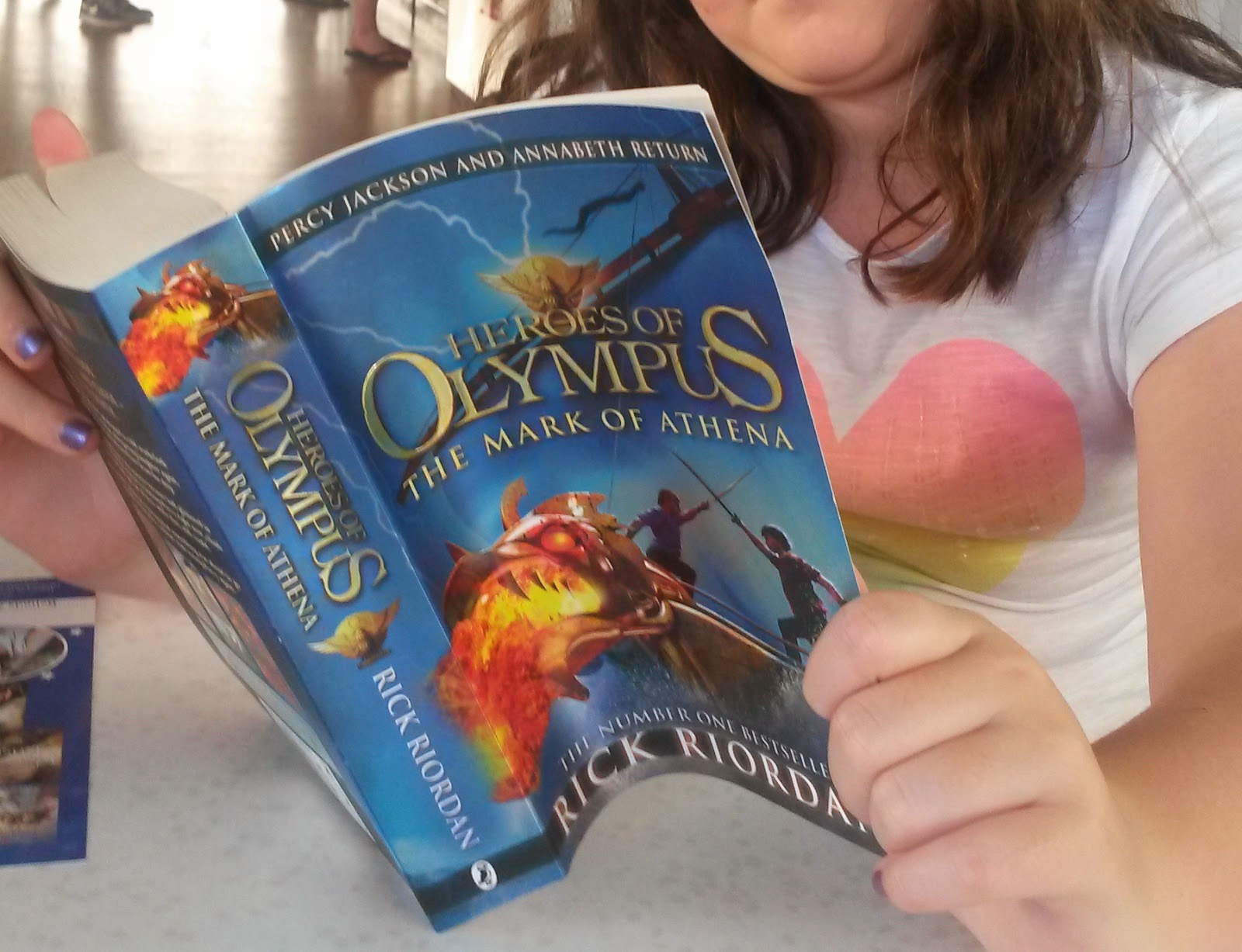
My about-to-be-11-year-old, A, is very deeply entranced with Rick Riordan's Percy Jackson and Heroes of Olympus books at present.

She's read all the Percy ones at least three times each, and is now working her way avidly through the Olympus books. She read at cafes, walking on the street, lying in bed, on the beach, by the pool ... from when she acquired the book pictured (on day 5 of our holiday) until she had read it cover to cover TWICE, she was not super interested in doing anything else! Thankfully, that only took her about 48 hours all told.

She's also gotten into a new series called The Luck Uglies (the book is, apparently, going to be the first of a trilogy). Her taste for fantasy, especially dark, tricksy fantasy, is very pronounced at the moment, and it's provoking some interesting discussions.

Next down is the 9 year old, E, whose obsession and delight right now is the Harry Potter books. She's rounding the corner towards the finish-line on book 6 and takes great delight in reading lengthy passages aloud to demonstrate to me (I am, granted, not a Potter fan myself) how incredible they are. We had a few reservations about her reading the later Potter books - she is, after all, only 9 - but she is coping with the darker themes well and after all, it would've felt rather mean to let her get engaged in the story and then make her wait years to see it end.

In a perhaps not unrelated development, E is also greatly enjoying Enid Blyton's school stories at the moment - particularly the St Clares books and the Malory Towers books.  She herself not infrequently notes similarity in underlying themes or treatments between Blyton's old-skool schools and Hogwarts; it's interesting to see her make these connections and enjoy the resonances that Rowling uses to enhance the Potter stories. I've hunted up my old Chalet School books for her to try; I think she's probably ready to enjoy them too.

Even though both A and E are extremely competent readers, we still do read-alouds of chapter books. I enjoy reading to them, the time together and the conversations it starts. They like the cuddly together time and the feeling that we are all sharing in a journey together. At the moment, I am reading them Susan Cooper's inimitable Dark is Rising series; we are in the fifth and final book, Silver on the Tree. Next up we are going to do Diana Wynne Jones's Power of Three because I loved it sincerely when I was 12 and I want to read it again :-)

My 5 year old, C, is just starting to crack the code of reading herself, and is very, very interested in having books read to her that either use pattern and rhyme, or contain lots of words she can recognise or clear visual cues for words. However, she doesn't like really "babyish" (her word) or reader-style books - she wants plot! She wants entertainment!

To that end, we've been revisiting lots of Dr Seuss at bedtime - she is especially fond of The Sneetches and Other Stories, The Lorax, The Cat in the Hat and Daisy-Head Mayzie. She is also super keen on her Charlie and Lola books again - I have only realised now, watching her interact with them, just how well Lauren Childs wrote those books to be not just funny and appealing, but accessible to new readers. There is a preponderence of word choices that support reading development and promote success, and I love that about them.

One thing that isn't so much in this category, but that C is adoring (and I am adoring reading to her), is Elisabeth Beresford's classic The Wombles. I myself first became acquainted with The Wombles in childhood via the BBC TV show, but the book itself as an untrammeled pleasure, and reading it to C is lovely.

We're back into school and work now, which can mean that reading slows a little, but I expect we'll still find lots of corners of time that a book is the best way to fill!

Sunday, June 22, 2014

Reading Notes: The Sharing Knife

I am a latecomer to the wonder that is Lois McMaster Bujold. I only discovered her for the first time when attempting the 2013 Hugo Prize nominee list, where I read the charming science fiction action-adventure-romance, Captain Vortpatril's Alliance, with great delight. I have subsequently worked my way through the inimitable Vor back catalogue (Miles, Cordelia, Ekaterin ... how deeply do I love thee) and segued into Bujold's fantasy constructions with high anticipation.

The Chalion books did not disappoint - well, they only disappointed to the extent that there are only three of them, and there should have been five because I am Not Happy that not all the gods got a story. But anyway, bygones.

With this background in mind, I approached Bujold's other fantasy series, The Sharing Knife books, with expectations of being entranced, engaged and excited again. In this, I was destined to be ever so slightly let down. While these are undoubtedly good books - well-crafted, intelligently written, internally consistent, with a complex and rich world - and I did find them enjoyable enough to persist to the end of book 4, I also found them much less my cup of tea than either Vor or Chalion, and I doubt I'd read them twice.

I've been trying to put my finger on what it is about these books that did not resonate with me, and I've pinned it down to three things.

Firstly, the world Bujold has created in these books appears to me to be modelled on a sort of American frontier-Western mythos, with a substantial side helping of 19th century riverboat culture. Being Bujold, she twists and tweaks this basis in lots of interesting ways, and the insertion of the magery, with its particular rules, is neatly done, but the folksy ambience that remains, especially in the dialect, grated on me a bit. Droppin' final g's may be a quick shorthand for invoking down-home aesthetics, but it's also annoying, although I grant that I am hardly the ideal target audience for it, being neither USian nor a fan of the Western genre overall.

Secondly, unlike in all Bujold's other series, I didn't take to the female lead at all. Fawn Bluefield isn't Bujold's only sweet young thing heroine - although, to be fair, Chalion's Iselle isn't so much sweet as intransigent and naive, while Hallowed Hunt's Ijada is afflicted with a dark curse right out of the gate, which lends her depth. Fawn is by far the most stereotypically young-girly, though, in ways that I found irritating.

Bujold generally writes older female leads and writes them incredibly well; Fawn, this 18-year-old farmer girl caught up in a series of variously fortunate and unfortunate events, doesn't come through nearly as vividly or convincingly as, say, a Cordelia, an Ekaterin, or my own favourite, the widow Ista (of Paladin of Souls). Even the early tragic event that brings her and her husband into each other's orbit, and is meant to give her a bit of shading, I suspect, just ... doesn't, for some reason. Fawn's character shows little or no development from the start of book 1 to the finale - she is, and remains, a pragmatic, bright, cheerful, not very self reflective, somewhat resourceful but still dependent girl. I didn't relate to her, and my interest in her fate was of the mildest variety only.

Thirdly, and I think this follows on from my reservations about Fawn, I found the central relationship really blergh and even at times offputting.

Bujold usually writes relationships that challenge paradigms, and usually does it incredibly well. The romances of Cazaril and Betriz, Miles and Ekaterin, Aral and Cordelia, Ista and Illvin,  Ingrey and Ijada, Ivan and Tej, all feature age, class and background incongruity, and the ways in which these resolve is what makes these satisfying love stories rather than scluppity-schlupp (that's my technical term for most romances, btw). Now I come to think of it, she does have a penchant for pairing older men with younger women (Ekaterin and Ista being the only two roughly age-matched women I can think of in the books), but it's never skeevy or wrong, and the women can always more than hold their own.

Except here.

The romance between Dag (who I also didn't madly love as a character - enough with the self-flagellation, dude) and Fawn is clearly meant to be about "transgressive love breaking all the rulez and leading the way into a brighter tomorrow". And had Fawn been a mature farmer woman - a widow, maybe, or a craftswoman, or something - then I think this might have come off. The class and cultural differences between farmer and Lakewalker would still have existed, and been just as potent and capable of exploration.

But as it is, the dynamic between  57-year-old Dag and 18-year-old Fawn is a bit skeevy, not least because of the way that Fawn is represented as naive, innocent, and pliable. The terms of their relationship, the tone of it, veers uncomfortably close to a paternal-child bond quite often, and this is fed by the fact that across all four books, it is Dag and not Fawn who makes the running and decides the course of events. Dag takes them to his home camp; Dag decides to leave it; Dag puts them on the riverboat; Dag decides to become a healer; Dag decides when they leave the second camp; Dag joins them up with a mixed caravan; Dag even (and OK, I found this the creepiest bit) decides when and how they will have sex based on his magic-y sensing of Fawn's fertility.

This lack of basic agency that Fawn has is obscured by the fact that Dag isn't a dictatorial or abusive husband, and Fawn gets to do lots of things and figure a few things out. It becomes more apparent, though, when you ponder that all the things she turns her mind to and discovers are things that are in aid of Dag's projects, interests and imperatives. Indeed, Fawn's main role in the story is as Dag's talisman, sounding board, foil and pet - much as Bujold is at pains to try and disclaim it (and on this, I think she protests too much).

So, overall, I would say these books are let down by one thing that's purely a matter of taste (the Western aesthetic) and two things that are uncharacteristically clumsily executed in Bujold's terms - the character of Fawn and the relationship between Dag and Fawn. I did not dislike the series by any means, and the plot was complex and satisfying; but I am in no hurry to make these characters' acquaintance again.

Sunday, March 30, 2014

Reading Notes: Fairytales for Wilde Girls and Hunting

This double review covers book 1 and 2 of my commitment to try to read and review the YA nominee list for the Australian speculative fiction awards - the Aurealis Awards. 2 down, 3 to go, and the clock is ticking as the prize is announced in 6 days! I hope to get another double review up on Wednesday, all being well.

These two books are not greatly like one another, but as I read them back to back, I thought I might indulge in a little comparative reviewing, just because I can.

And come to think of it, although the style, themes, voice and tropes are quite different, both are books about strong young female protagonists who are not rescued by anyone (in fact, do a good deal of rescuing themselves), who struggle with difficult, malignant magic, who create affective bonds with friends and lovers on their own terms, and who, despite all indications to the contrary, get their happy (ish) ending.

In other words, both are quintessentially YA fantasy stories - full of moral quandaries, excellent characterisation, and hope in the face of trying circumstances.

Hunting is decidedly the "straighter" of the two as fantasies go - it's a fairly uncomplicated, although not un-nuanced, magical-danger-quest-redemption story, set in a competently realised cosmos that is briskly and efficiently explained.

It revolves around main protagonist, Ash Lenthard, who has a secret to which we are privy immediately but the cast of the book spends an inordinately long time failing inexplicably to grasp. Ash and her posse's struggles to diagnose and then cure the magical woes of their kingdom are not exactly the most amazing or original storyline I have ever read, employing quite a few standard sword-and-sorcery tropes in a way that struck me occasionally as just a tiny bit paint-by-numbers (although having said that, they were all technically accomplished in their delivery).

So that's my main criticism, that the plot isn't incredible or surprising - we are talking a fairly dead run from presentation of problem to standard solution here - but what makes this book so good (and it really is very good) is Host's sure touch with her characters and her dialogue. All the characters in this book are vivid and enormously appealing, and the relationships that unfold between them are immensely enjoyable and authentic. Ash herself is a terrific character, and the relationship that grows between her and Thornaster is simply brilliant. Their banter reminded me of something - something very well beloved - as I was reading it, but I couldn't pin it down until I read Host's own comment on Goodreads and realised - this is fresh, modernised Georgette Heyer, a witty and feminist take on the delights of that dialogue that completely entranced me.

Fairytales for Wilde Girls is a cat of another colour in terms of its style and storyline, and its protagonist, Isola Wilde, is a very different girl to Ash, battling stickier and trickier demons. Whereas Hunting is set in a fantasy cosmos, which enables Host to give it whatever rules she wants, Near does something a little harder to pull off, which is locate Isola in the "real" world but with one foot in an unseen (to most) magical sub-realm. Fairytales is, I think, more innovative in its plotting and perhaps more interesting in its tangled, weirded style, although it does use one enormous gotcha of a plot device that would probably be much more effective if you don't spot it about 1/3 of the way through like I did. (I can't help it, I'm a mystery reader; I'm used to unpicking the clues).

Isola is a great character, as are several of the supporting cast in this story too - I particularly loved Alejandro, Ruslana, Grape, Jamie and Edgar. Isola's strength is of a different type to Ash's straightforward heroics - facing massive internal as well as external pressures, she fights a subtler, but more dreadful, war. In all ways Fairytales is a darker and more disturbing book, and - yes, I think so - a less enjoyable book than Hunting, in that purely reading-for-pleasure way. That is not to suggest that it's a lesser book, because it certainly isn't - I think it's a more complicated achievement in many ways. It requires an emotional effort and investment that isn't demanded by Hunting, that's all.

Overall, these are both extremely good. They're different books for different moods, and it's hard to say one is better than the other per se, because it would depend entirely on your frame of mind. I think Fairytales is more complex and probably more original, but I found Hunting so purely enjoyable in its Heyer-esque frolics that I'm more likely to read it again. Two excellent contenders for the YA prize, and I would not be sorry to see it go to either of them.

Note: I mentioned in my earlier post that one of my motivations for choosing the YA category to read was to scope new books for my almost-11 year old. On balance, I would advise against Fairytales for the tween reader - it really is quite disturbing, and I know that my own almost-11 would find it upsetting. Hunting, on the other hand, is a great choice for advanced readers from that age upwards - any kid that's able to keep up with and enjoy Harry Potter or Percy Jackson would be well able to take this on.

Wednesday, March 26, 2014

Reading Notes: Nebula short stories

I'm over at Global Comment today, talking about the short story nominees for this year's Nebula Awards. Hope you like it!

Sunday, November 10, 2013

Reading Notes: The Curse of Chalion, and the role of religion in fantasy novels

I finished reading Lois McMaster Bujold's fantasy novel, The Curse of Chalion, this morning. I'm a latecomer to the wonder that is Bujold. I first came across her in this year's Hugo novel list, with the hilarious and awesome Captain Vorpatril's Alliance, which prompted me to get stuck into the Vorkosigan books (a journey frequently interrupted, but I'll get to end soon I hope). Although not particularly hard sci fi, the Vor books are undoubtedly science fiction, and also very witty and often funny. I wondered how Bujold's voice would work in a more fantastic setting, with the particular tropes that fantasy often employs.

The first thing to be said is that Chalion is a very good book indeed. It is original - ish - in its conception and delivered with Bujold's customary flair and facility; while not as funny as the Vor books often are, the author's dry wit is still evident throughout.

It's certainly not shy about utilising some of the more common sword-and-sorcery archetypes of fantasy writing, which is why I say it's original-ish (a magical curse, hello! a lone saviour with a dark past, you don't say! a villain who holds a fair maiden captive, how about that!) Bujold's glosses on these well-worn themes, though, are what make the story - the gestures to medieval Spanish court culture, the genuinely labyrinthine politicking and plotting, the subversion of the "helpless maiden" device in the person of the fearsomely intelligent and driven Iselle, the strength and appeal of the characters.

The main character of the book - the tortured saviour, who has to die three times to deliver the royal family from the curse that hangs over it (yes, l I know it sounds cheesy, but go with me here) is Lupe Cazaril, a 36 year old who looks and behaves older, largely due to what he has suffered  before the commencement of the action. Caz is not my favourite of Bujold's characters, to be honest - he's so much less vibrant than a Miles or a Cordelia (or even than Iselle in this very book). That said, I'd probably be less than filled with life too with the backstory that Bujold gives this poor guy.

Because of the course of events that is set in motion when Cazaril, as the secretary to the Royesse (Princess) Iselle, travels to the capital with Iselle, her brother Teidez, and their attendants, Cazaril ends up spending a lot of time mouthpiecing about religion, spirituality, the gods, death, life, the relationship between life and death, and faith. The religion Bujold constructs for Chalion is based around a quintet of god figures - the Father, Mother, Daughter, Son and the Bastard - and each divinity has its own characteristics, its own particular powers and adherents, and its own role to play.

This is a world in which the gods do not speak plainly to women and men, and do not, cannot, intervene in the world except via human consent. Bujold sets a very high store on free will, and on the gods' ability to act, to perform miracles, being constrained by human will and faith. Here, a god may intervene by providing, providentially, access to two fresh mules to a traveller in need, rather than with dramatic thunderbolts and pronouncements from on high. The gods are not superpower-possessing people; they are inscrutable, inhuman, unknowing and unknowable, immense beyond measure, ever-present yet ever-restrained by the potency of human minds.

I liked Bujold's vision of religion and spirituality very much, and found it persuasive and well integrated into her storyline in ways that are not always true of fantasy novels. I think it primarily based on the melding of a particular kind of Protestant Christianity, which is very concerned with the notion of free will and faith, and an almost Buddhist notion of self and souls. I'm reliably informed that the role of the fifth god, the Bastard, comes to the fore in the next Chalion book, which I'm looking forward to.

It made me think on what role religion and spirituality play in other fantasy texts I have read. They're often bound up with ideas about magic, prophecy and sorcery, of course, which are almost ubiquitous in classic fantasy, but there are some notable fantasy texts that are god-less and organised-religion-less (the most obvious example is The Lord of the Rings, but there are plenty of others). Where religion does have a part to play, though, it seems to me that the most common modellings are on Christianity (both of the Roman Catholic and Protestant variety, although almost always of historical, rather than modern, iterations thereof); Buddhism; or Viking / Greek / Roman polytheist, gods-as-powerful-people tropes. David Eddings' enormously popular Belgariad and Mallorean books, for instance, sport a pantheon of gods that are remarkably easy to tag with their various Viking and Roman origins.

I could go on, but I won't. The point I'm trying to make here is that I'm doubtful that any fantasy world's religion / spiritual practice is created of whole cloth by the writer. Of course, you could argue this of many themes, but particularly when it comes to the matters of the soul, people seem to gravitate towards patterns, themes and axioms that are known and familiar, to help to explicate the unknown, the unfamiliar. I don't know what, if anything, this means, except maybe that humans are creatures of habit, and that cultural programming runs deep.

In my own attempt at writing a sort-of sci fi, now paused while I try to get my feet under me with my new job, I've been intrigued to find that my world has a kind of vague mystical / animist ethic to it without having any systemic religion (that I have yet introduced, and as it's not in the plot plan, it's not likely I'll put it in now). The society I'm writing is dispersed and fragmented, and, for a very particular reason, could be considered post-religious in many ways. This tells me some interesting things about how I think about the basis of faith and spirituality and religion, and what I intuit might render them incapable of gaining serious traction in a society.

So I guess I think religion and spirituality, while they add depth to fantasy if done well (and completely destroy it if done badly), are rarely original in their conception and execution, and tend to draw from the already wide palette of real-world religious experience.

Do you agree, if you're a fantasy reader?

This is post 10 in NaBloPoMo. A third of the way there today - 10 down, 20 to go!

Sunday, July 7, 2013

Reading Notes: The Stars Do Not Lie

This post is part of my commitment to read and review as many nominated works in the Hugo Awards (Science Fiction Awards) as possible before the prize announcements in early September.   Today I am looking at the last of the five nominated novellas: Jay Lake's The Stars Do Not Lie.

The first thing to be said about this novella, for me, is a warning: if steampunk isn't your thing, I don't think you'll like this. It's not a classic steampunk formulation, although it does have the obligatory airships; this novella isn't set (necessarily) on earth and isn't tied to any real historical period. However, the whole - for want of a better word - mouthfeel of the text is very steampunkish. Technology and repression, bizarrities and futurism, the red-gold antiquarianism of it; it's all very Alan Campbell to me.

I am neither a booster nor a hater when it comes to steampunk. I have loved some notable works in the genre (Perdido Street Station, The Difference Engine, and recently, Jean-Christophe Valtat's Aurorarama) but I have also disliked or been bored by quite a few others. For me, it's a chancy genre - do it well and it's awesome, but stuff it up and the fall is very far.

I've not read anything else by Lake, although my friend Professor Google tells me he is prolific (I may have some catching up to do!) One thing this novella immediately makes clear, though, is that he is a practised and clever practitioner of steampunk. This story is smooth as glass in the way it integrates technology and machinery into the plot, and the aesthetic it achieves. I found Lake's style engrossing and mellifluous, which made the story enjoyable to read.

The plot of this novella hinges on a theme that could fairly be described as An Oldie But a Goodie in speculative fiction - the conflict between science and religion. The discovery by a scientist of what appears to be an orbital spaceship, and the implications he draws for the belief system of the world, leads to the kind of frantic religious flailing that would have been quite familiar to, say, Galileo. Indeed, although Lake makes up a religion (based around worship of the Increate) for his story, it is an extremely thinly veiled fictionalisation of the Renaissance Roman Catholic church. So fine is the distinction that when I mentally substituted clerical ranks from the Catholic church for the names in Lake's story, it made even better sense.

The story is well executed, but I thought ultimately non compelling. I have read many, many other versions of this theme in speculative fiction, a lot of them more engagingly rendered than this one. I also thought the novella came to a very vague and unsatisfying ending - it almost felt like it stopped halfway, which is a risk of course with novella but one that the best works avoid.

All in all, it's worth a look if you like steampunk, but to me it's not the category winner.

So now I have read all five novellas, which one should win, in my very irrelevant opinion?

I'd give it to either On a Red Station, Drifting or The Emperor's New Soul. Both of them are excellent works that show brilliantly the virtues of the novella form rather than its shortcomings. Both are original, engaging, moving and vivid. If I had to pick one, I'd go with On a Red Station by a nose, only because I love the world creation so much in that story. But the Sanderson would be a good winner too.

There is a free copy of The Stars Do Not Lie available for download at http://www.asimovs.com/pdfs/Stories/The_Stars_Do_Not_Lie.pdf

_______________________________________________________

So - that's a wrap for the novellas. Four novels to go, plus all the novelettes! Next up will be the novelettes as a set - all 5 if I can get hold of the last one, or the 4 I have found if the elusive "Rat-Catcher" remains unobtainable.

Then on to the novels. I'm almost finished 2312, so it'll be next - hopefully next week sometime. I may not do a full review of Throne of the Crescent Moon because I'm not enjoying it enough to finish it, and I think reviewing a book you haven't finished is a bit dubious. I'm halfway through Blackout, which I will review, but haven't found either an ebook to buy or a library copy to loan of Captain Vorpatril’s Alliance yet.
 

Other Hugo reviews can be found here:
Short stories (all)
On a Red Station, Drifting (novella)
After the Fall, During the Fall, Before the Fall (novella)
The Emperor's New Soul (novella)
Redshirts: A Novel and Three Codas (novel)  

San Diego 2014: The Last Stand of the California Browncoats (novella)

Friday, April 19, 2013

Reading Notes: Bitter Greens

Next up on the Aurealis list for me was a book from the Fantasy Novel nominees - Kate Forsyth's retelling of the Rapunzel story, Bitter Greens.

I've been pairing books from the Sci Fi and Fantasy lists in my reading, which can be a little dizzying, but also really helps me to assess books on their merits rather than in terms of "are they exactly like the previous title which I enjoyed or hated??" which is a bit of a trap when reading solidly in one genre. So far, I've read 2 from each list - Sea Hearts and Bitter Greens from the fantasy list, and And All the Stars and The Last City from the sci fi list. Review of The Last City at the weekend if I get time! I've just started Garth Nix's Confusion of Princes, another sci fi title, and Jo Spurrier's Winter Be My Shield (fantasy), but with the next three weeks looking a bit craptastic in terms of time, I don't expect to finish and review them until mid-May.

Enough of that - on to Bitter Greens.

The first thing to be said about this book it is that it is one of that rarest of achievements in fiction - a really successful genre-blender. Told through the lens of the life of real French aristocrat and author at the court of the Sun King, Charlotte-Rose de la Force, the story is a vivid, engaging and entirely satisfying historical novel, picking apart the conventions and limitations of Charlotte-Rose's social milieu and the terrifying religious persecutions that Louis XIV inflicted on France's Hugenots (Protestants).  At the same time, it is also a beautiful, savage retelling of the Rapunzel story, set in a historical-yet-magical Venice of the sixteenth century. The hook that ties the two together is that Charlotte-Rose was, in reality, one of the first popular writers of the Rapunzel myth, bringing an older folktale to the attention of the court (and, subsequently, the world).

What I loved the most about this book was the powerful, persuasive characters who drive it. To me, the main protagonists are unquestionably Charlotte-Rose and Selena Leonelli, La Strega (The Witch). Margherita, the Rapunzel of the mythic half of the story, seems straightforward, almost muted, beside these two magnificently messy, mixed up, vibrant, living women, one basically good, the other ... well, it's complicated.

In fact, it is in the character of Selena that I think Bitter Greens reaches its peak power. It is no mean feat to create a character who is at once really repugnant - selfish, brutal, sinuous, and yes, evil - and is still human, still driven by fear and past scars, and filled with the belief that what they do is justified (so does not see themselves as evil, although is uneasily aware that their actions have unwanted consequences for others). Giving us the backstory of the witch is the narrative decision that, to me, sets this book higher than several other fairytale mash-ups I have read. Selena's mother's fate (warning note here: strong stomach needed, this section is extremely confronting and horrific) casts an inescapable shadow over the whole of Selena's life, right til the moment that the spell is finally broken. It is a sign of how deeply Forsyth has been able to persuade us of Selena's humanity that when Margherita is able to break the enchantment, the sigh of satisfied relief is for Selena's release as much as for Margherita and her lover.

Overall, this was a really excellent book. I read it quickly, found it engaging even when confronting, and possessed of the requisite appropriate ending that a story melding history and myth should have. I'd recommend it to "traditional" fantasy lovers and historical fiction fans alike.

Friday, February 1, 2013

Reading Notes: Sea Hearts

I feel I should start my review of Sea Hearts with some full disclosure: I loved this book. Loved it in the kind of bone-deep, part-of-my-mental-landscape kind of way that is usually, for me, an insuperable barrier to writing any kind of useful analysis, let alone criticism. I tend not to review books, or films, or tv shows, which have snarled themselves this deeply into my affections; firstly because I find it hard to quantify, let alone qualify, my praises, and secondly because it almost feels transgressive to write about stories that have crossed the eye-heart barrier, as if I'm giving away more of myself than when I write about good, interesting, but ultimately less important (to me) texts.

That was a really long-winded and self-indulgent way of saying that this is not going to be an analytical or theoretical review. I am not going to talk about the devices that Lanagan uses or the pacing, style or plotting glitches, if any. This review is going to be about how Sea Hearts made me feel, and why.

The story that Lanagan tells in this book is a riff on the folktales and mythology about selkies: the seal women, who live as seals in the sea but are capable of shedding their sealskins to assume human form. Setting her tale on a remote fishing island, Rollrock, Lanagan has adopted many of the key elements of traditional selkie mythology - the beauty of the selkie women, their desire to return to their seal form and the sea, the human men being besotted with them and hiding their sealskins to prevent their return. What she's changed, however, adds a power and aching to the story that carries out out of "well-told folk story" into something truly great. In Lanagan's conception, the selkies do not simply and voluntarily come forth; they are called out of their seal skins by the skill, or magic, of Misskaella, a local woman who is rejected by her own community for being strange, unlovely, and weird, in the old sense of that word.

Oh, Misskaella. Was ever a character more completely drawn? From when we meet her, as a dumpy, persecuted child, to her death near the end of the book, Lanagan never stops adding layers and twists to this woman. To me, she is the main character of the book, although others might disagree (and, truth be told, it is an ensemble cast - a book about a community and how it works, not about individuals as grand isolated forces). The power that infuses Misskaella, the ability to see the potential human form inside the seal's body and to draw it out with song and charm, is nothing she asked for, but she makes it do her dismal work, calling forth sea maiden after sea maiden to the ultimate fragmentation of the whole island. Rejected and reviled, she bites down on her sorrow and rage and, with ice cold prescience, sets in motion the events that will drive all the "red women" from Rollrock, and inflict permanent pain on all the men. She does this knowingly and greedily, and profits enormously by it.

Yet she's not hateable, not to me. Here is the woman who sings forth a seal man for herself, in her loneliness, and discovers that she is beautiful, worthy, despite what she has been taught:

And here was a wonder, that a man so well-conformed himself should be so eager to embrace what I had always been told was a poorly-made body, laughable, even disgusting. But I delighted him; he travelled my curves, weighed me in his hands, pressed me and gasped with me as I yielded. Open-faced he looked into me, his eyes empty of the scorn I was used to seeing, in women's faces as well as men's. Instead he was only another creature discovering skin ... Exultant, I watched as my life tore free like a kit from its string and flung itself up into the windstorm that was the future.

Here is the woman who births selkie-sons in secret, and has to return them to the sea so they might survive as seals:

He broke my heart with his celebrating - how little he needed me, how perfectly happy he was now, as he had not been before, in my house, at my breast! I was glad of his gladness, and that he would be cared for, but how would I live without him, the little prince who had ruled my days and nights?

Here, too, is the vengeful woman, who brings the first selkie to shore knowing the effect she will inevitably have on every man who sees her, and how this will, in time, create a society of seal-wives and human husbands. All these sea-born mams with their ineffable beauty and pliancy and sadness; all the daughters that must be returned to the sea, like Misskaella's sons; all the longing that will poison the well of happiness on this island, build life on a false rock of seeming and magic rather than red-faced reality.

The resolution of this multipartite tragedy feels both inevitable and excrutiating. I'll avoid spoiling too much, but suffice to say, those born of the sea return to it. Trying to explain to his father, the selkie Neme's son, Daniel, says:

'You want me to say she missed you. But do you want me to lie? I did not see it. But did that mean she didn't grieve after you? ... But as for how was she? She was her own self in the sea, that's all.' I tried to find a way to explain it. 'She was not in pain, you know, from her feet, and she could move, so well and so easily, not like under the blankets here, all weighed down -'
'She was happy, then,' he said.
I shook my head. 'Not even that. But she was freed of ... she didn't have the sadness that she carried around up here. So I suppose, yes, she was happy...'

The unwisdom and ultimate misery of trying to deny nature, and the painfulness of dividing a heart between two worlds, underscores all the plaintive emotion in this book. Ultimately, Misskaella's charms serve as a kind of sickly glamour that can only be cured by the love of a son for his mother, a love and sacrifice that he exercises in the same way that the witch herself gives her beloved sons back to the sea. It is such a powerful, heart-tearing cycle, and Lanagan lets it settle in without ever over-egging the pudding, allowing the many strands of this tangled web to reveal themselves as the story progresses.

As to how this book made me feel: Terribly sad. Enormous unnameable longing. Beautiful and powerful. Compassionate, for all the flawed people and all their little sins that led them to this end.

It is a wonderful, life-infusing book. I really don't care if you don't normally like fantasy or folklore-type fiction; please believe me, this is worth departing from type for. Read it and you will know why.